
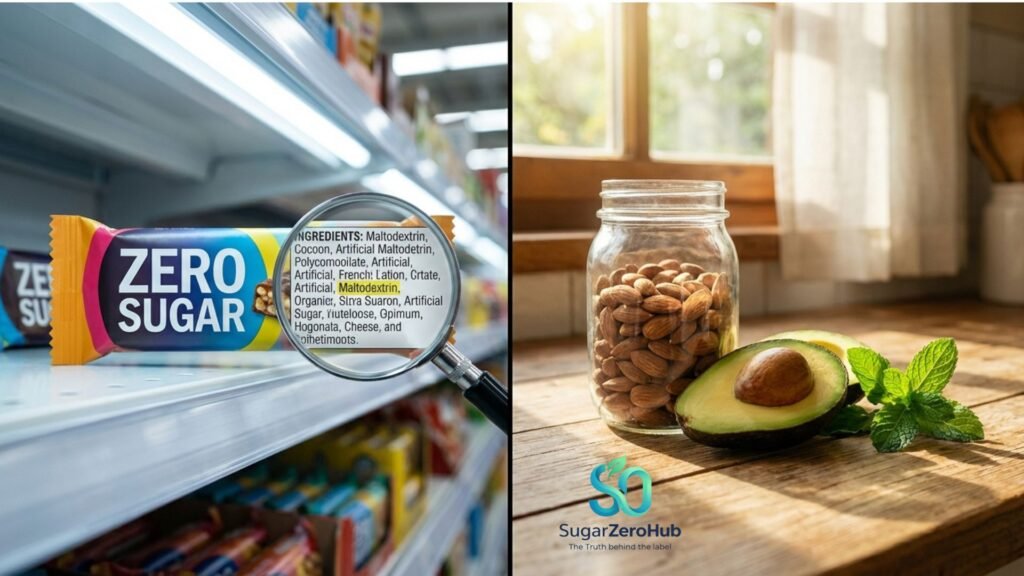
You are actively trying to manage your blood sugar, so you make the responsible choice. You walk past the regular candy and soda aisles and head straight for the “Diet” and “Sugar-Free” section. You buy zero-sugar cookies, diet sodas, and sugar-free syrups, feeling proud of your discipline.
But a few hours later, your energy crashes, you feel intensely hungry, and if you are wearing a continuous glucose monitor, you might even see a spike. How is this possible if you consumed zero sugar?
Welcome to the darkest corner of food marketing. The label on the front of the package is lying to you. “Sugar-free” does not mean “insulin-free,” and understanding this difference is the key to truly healing your metabolism.
1. The Maltodextrin Trap
If a product has the sugar removed, the manufacturer has to replace it with something else to maintain texture and bulk. Enter Maltodextrin.
Maltodextrin is a highly processed carbohydrate powder, usually made from corn or wheat. By FDA standards, it is technically not a “sugar,” so companies can legally use it in “sugar-free” products. Here is the terrifying truth: regular table sugar has a Glycemic Index (GI) of 65. Maltodextrin has a GI of up to 110!
It spikes your blood sugar faster and higher than pure table sugar. If you see “Maltodextrin” on the ingredient list of a sugar-free snack, you are eating a metabolic bomb in disguise.
2. The Cephalic Phase Insulin Release
Even if a product uses a true zero-calorie artificial sweetener (like sucralose or aspartame) that doesn’t physically contain glucose, you are still not entirely safe.
Your digestion begins in your brain. When your tongue tastes something intensely sweet, it sends a signal to your brain: Sugar is coming! Your brain, preparing for the incoming load, signals your pancreas to release a small amount of insulin into your bloodstream. This is called the Cephalic Phase Insulin Response.
Because no actual sugar arrives for that insulin to clear out, your blood sugar drops slightly, triggering intense cravings and hunger. You end up overeating later in the day because the artificial sweetness tricked your hormones.
3. The Gut Microbiome Massacre
Emerging science is showing that frequent consumption of certain artificial sweeteners drastically alters the bacteria in your gut (your microbiome). Your gut bacteria play a massive role in how your body handles glucose.
Studies have shown that disrupting this microbiome with chemical sweeteners can actually induce glucose intolerance and insulin resistance over time. You are trying to prevent diabetes by drinking diet soda, but you might be actively creating the gut environment that causes it.
Stop Reading the Nutrition Facts
The biggest mistake you can make is looking only at the black-and-white “Nutrition Facts” panel. The food industry manipulates those numbers. To protect your blood sugar, you must read the Ingredients List. If it reads like a chemistry experiment, put it back on the shelf.
To truly outsmart the food industry and achieve permanent metabolic health, you need a complete understanding of how to read labels, sequence your whole foods, and naturally balance your hormones.
Don’t fall for the marketing traps: Read The Ultimate 2026 Guide to Mastering Your Blood Sugar here
Conclusion
“Sugar-Free” is a marketing term, not a medical one. By eliminating highly processed artificial sweeteners and hidden starches like maltodextrin from your diet, you can silence the hidden insulin spikes, heal your gut, and finally break free from the cycle of cravings. Choose real, single-ingredient foods, and your metabolism will thank you.