
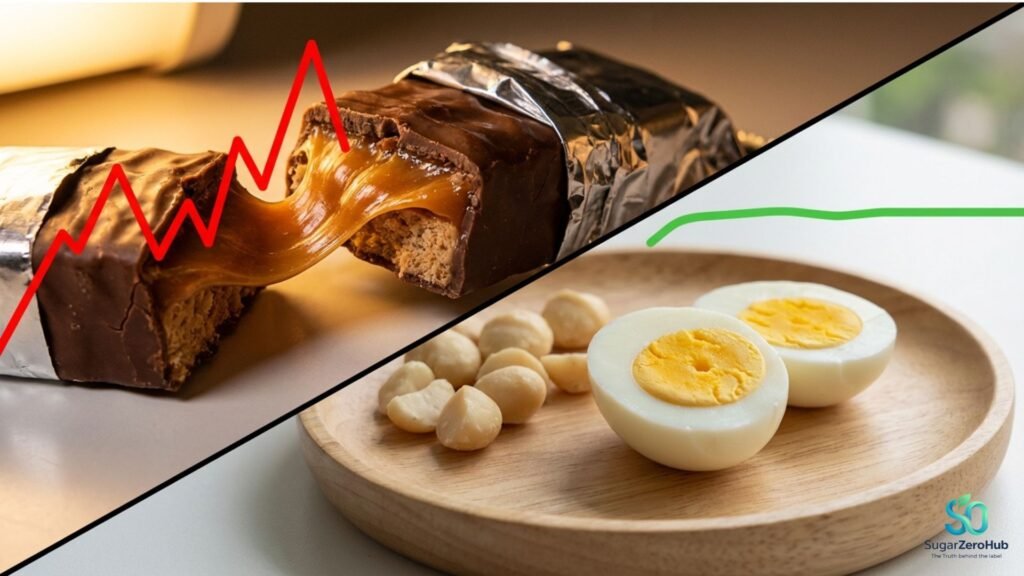
You are running late, trying to stick to your weight loss goals, so you skip the fast-food drive-thru. Instead, you unwrap a chocolate-coated “Low-Carb” protein bar. The packaging promises massive amounts of protein, low net carbs, and zero sugar. You feel disciplined.
But two hours later, you are dealing with a bloated stomach, a severe energy crash, and an intense craving for more sweets. Worst of all, the scale has not moved in weeks.
How can a fitness food stop you from losing weight? You have fallen victim to the ultimate diet industry deception. That protein bar you just ate is not a weight-loss tool; hormonally, it is virtually identical to a candy bar. Here is the hidden science of why commercial protein bars are secretly spiking your insulin and locking your fat cells.
The “Maltitol Illusion” (The Science)
If a protein bar tastes exactly like a sweet, chewy candy bar but claims to have “Zero Sugar,” you must look at the ingredients list. Food manufacturers have to replace the sugar with something to make the bar palatable. Most of the time, they use a sugar alcohol called Maltitol.
Here is the terrifying loophole: because Maltitol is technically a sugar alcohol, the FDA allows companies to subtract it from the total carbohydrate count and label the product as “Sugar-Free.”
However, your body does not care about packaging labels. Maltitol has a Glycemic Index of up to 52 (for context, table sugar is 65). This means that when you eat a protein bar sweetened with Maltitol, it absorbs rapidly into your bloodstream, causing a massive, violent glucose spike. Your pancreas immediately releases insulin, which shuts the doors to your fat cells and completely halts your weight loss progress.
The Tapioca Syrup Glue
The hidden sweeteners are only part of the problem. To get that thick, chewy texture that holds the whey protein powder together, manufacturers use industrial “binders.”
The most common binders in diet bars are tapioca syrup, brown rice syrup, or IMO (isomalto-oligosaccharides). While they sound natural and healthy, these syrups are highly concentrated, refined starches. They digest in your stomach almost instantly, flooding your liver with glucose. You might think you are eating a high-protein diet snack, but you are actually consuming a highly processed carbohydrate block that drives severe insulin resistance.
3 Tactics to Spot a Real Fat-Burning Snack
You do not have to starve when you are on the go, but you must stop relying on processed candy bars in disguise. Here is how to navigate the snack aisle and keep your fat-burning pathways open:
The 5-Ingredient Rule
If the ingredients list on the back of your protein bar looks like a high school chemistry experiment, put it down. A real, metabolically safe protein bar should have no more than 4 or 5 ingredients—usually egg whites, raw nuts, and dates or a clean sweetener like pure Stevia or Monk Fruit.
Avoid the “Net Carb” Trap
Do not trust the large “Net Carbs” math on the front of the box. Turn the bar over and look at the Total Carbohydrates. If the bar has 25 grams of total carbohydrates and only 10 grams of protein, it is not a protein bar; it is a carbohydrate bar. Always look for a 1:1 ratio or higher (e.g., 20 grams of protein to 10 grams of total carbs or less).
The Whole-Food Swap
The ultimate way to ensure your blood sugar stays flat is to bypass the protein bar aisle entirely. Nature already pre-packaged the perfect, zero-spike protein snacks. Two hard-boiled eggs and a small handful of raw macadamia nuts provide the exact same amount of protein and healthy fats as a premium diet bar, but without a single drop of inflammatory syrup or artificial sweetener.
Losing weight is not about starving; it is about keeping your insulin low. To learn how to spot hidden sugars, decode food labels, and turn your body into a permanent fat-burning machine, you need the complete blueprint.
Unlock your fat cells and master your metabolism: Read The Ultimate 2026 Guide to Mastering Your Blood Sugar here
Conclusion
Do not let the “High Protein” label fool you. Most commercial protein bars are highly processed desserts packed with Maltitol and inflammatory syrups that violently spike your blood sugar. Ditch the fake diet foods, switch to clean, whole-food snacks, and watch your cravings disappear and your stubborn belly fat finally melt away.