
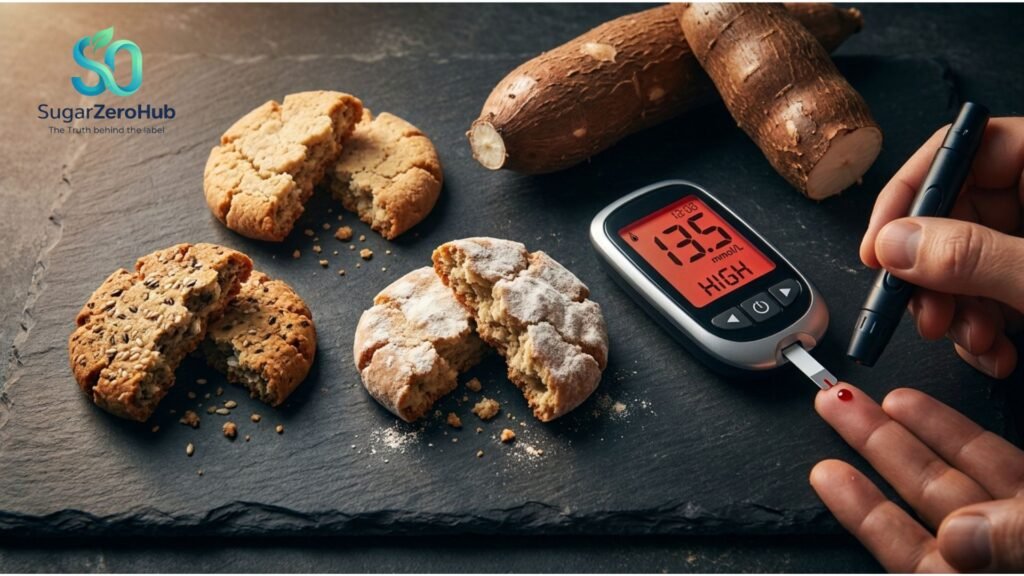
Walking down the health food aisle, you will see the “Gluten-Free” label plastered on everything from breads to crackers. For adults over 50 trying to reduce inflammation, going gluten-free seems like a smart metabolic choice. However, food manufacturers are hiding a massive blood sugar spike behind that healthy label, and the main culprit is often a popular ingredient: Cassava (also known as Tapioca).
While people with celiac disease or gluten sensitivity rightfully avoid wheat, barley, and rye, replacing them with cassava products can accidentally trigger a completely different metabolic crisis. It is time to expose the hidden dangers of the gluten-free aisle and protect your insulin response.
A Ilusão do Rótulo “Sem Glúten”
The biggest misconception in modern nutrition is that “gluten-free” automatically means “healthy” or “low-carb.” When food companies remove gluten (the protein that gives bread its stretchy texture), they have to replace it with something else to hold the food together. They almost always choose highly refined, gluten-free starches. You might think you are making a healthy choice by buying a box of gluten-free crackers, but without realizing it, you are consuming ingredients that act exactly like pure sugar in your bloodstream.
Por que a Mandioca (Cassava) Dispara a Glicose
Cassava root in its whole, natural form contains fiber. But the cassava flour or tapioca starch used in gluten-free baking and snacks is highly processed. The fiber is stripped away, leaving behind pure, concentrated starch.
Because it lacks the necessary fiber to slow down digestion, your body rapidly converts cassava starch directly into glucose. Eating a cassava-based tortilla or a handful of tapioca chips can cause a faster and more aggressive blood sugar spike than eating a slice of regular white bread. For anyone managing prediabetes or insulin resistance, this is a dangerous metabolic trap.
Alternativas Seguras para Substituir o Trigo
You do not have to give up baking or snacks to protect your blood sugar. The key is choosing alternatives that are not just gluten-free, but also low on the glycemic index. Instead of cassava or tapioca, look for products made with almond flour, coconut flour, or ground flaxseed. These flours are naturally rich in healthy fats and fiber, meaning they provide stable energy without the devastating glucose crash.
Navigating food labels can be confusing, but understanding these hidden traps is essential for longevity. To learn how to spot other metabolic dangers and master your daily nutrition, Read The Ultimate 2026 Guide to Mastering Your Blood Sugar here.
Conclusion
Protecting your health means looking beyond the front of the package. While cassava and tapioca are perfectly safe for those strictly avoiding gluten for autoimmune reasons, they are not your friends when it comes to metabolic health. A gluten-free label is never a free pass for your blood sugar. By becoming an educated label-reader and swapping high-starch flours for nutrient-dense, fiber-rich alternatives like almond or coconut flour, you can avoid the hidden dangers of the health food aisle and keep your metabolism resilient for years to come.