
If you have been struggling to lose weight despite cutting calories, counting points, or starving yourself, the problem isn’t your willpower—it’s your biochemistry. Traditional dieting tells you to eat less, but metabolic science proves that you need to eat smarter.
When you focus purely on calorie restriction, your body goes into survival mode, slowing down your metabolism and pumping out hunger hormones. To trigger sustainable, effortless fat loss, you must shift your focus from calorie counting to blood sugar and insulin control. By structuring your meals around high-quality lean proteins, metabolic fibers, and strategic complex carbohydrates, you can flip your body’s switch from fat storage to fat burning.
The Insulin Connection: Why Calories Aren’t Everything
Every time you eat, your body releases insulin, the primary fat-storage hormone. When you consume refined carbs or simple sugars, your blood glucose spikes, forcing a massive surge of insulin into your bloodstream. As long as insulin levels remain chronically high, your fat cells are chemically locked, meaning your body cannot access stored fat for fuel.
To lose weight permanently, you must keep insulin low and stable. Lean proteins (like grilled chicken breast or wild-caught white fish) and non-starchy vegetables cause virtually zero insulin spikes. They provide a steady, clean source of energy while allowing your body to naturally access and burn its own fat reserves throughout the day.
The Power of Protein and Viscous Fiber
Protein is the most thermic macronutrient. Through a process called the Thermic Effect of Food (TEF), your body burns up to 30% of the calories consumed from protein just trying to digest and break it down. Furthermore, protein stimulates the release of peptide YY (PYY) and GLP-1—the exact hormones responsible for telling your brain that you are full and satisfied.
When you pair lean protein with metabolic fiber (such as leafy greens, broccoli, or complex smart carbs like quinoa and sweet potatoes in controlled portions), you create a gel-like matrix in your digestive tract. This slow-moving matrix delays gastric emptying, meaning glucose is released into your bloodstream at a slow, predictable trickle rather than a sudden flood. No crashes, no intense sugar cravings, and absolute appetite control for hours.
The 3-Step Perfect Metabolic Plate Blueprint
Building a fat-burning meal doesn’t require complex calculations. Follow this simple daily blueprint to optimize your metabolism:
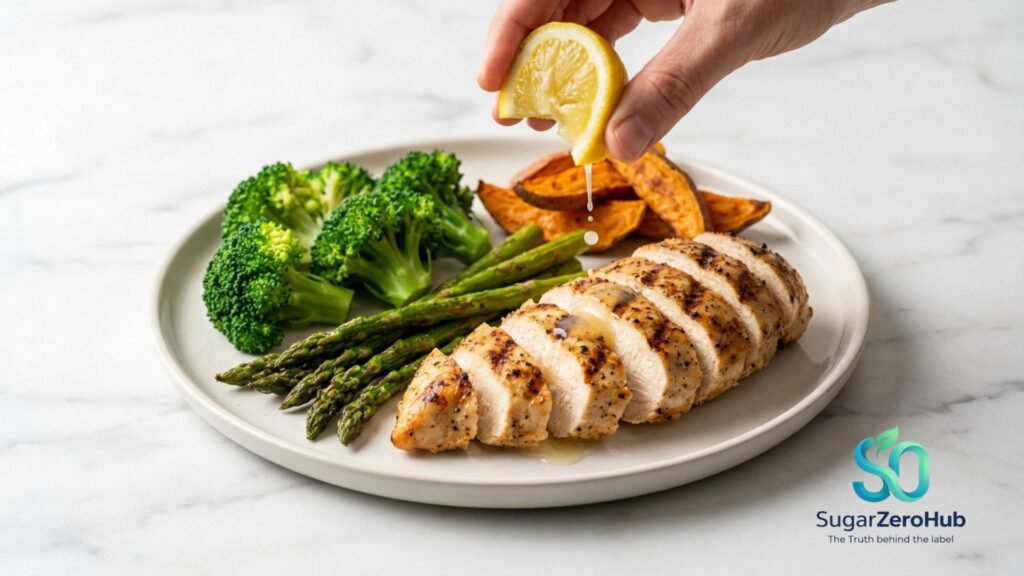
- The Protein Anchor: Fill half of your plate with a clean, high-quality lean protein. Aim for grilled chicken, turkey, or white fish cooked with minimal added oils.
- The Fiber Shield: Fill the other half with high-fiber, non-starchy vegetables. Think roasted asparagus, steamed broccoli, or a massive green salad.
- The Smart Energy Fuel: Add a small, controlled portion (about the size of your fist) of a complex carbohydrate like sweet potato or wild quinoa. Avoid deep frying or heavy oils, opting for baking or air-frying instead.
By keeping healthy fats minimal and clean during your fat-loss meals, you lower the overall energy density while maximizing nutrient density, forcing your body to look inward for energy.
Before optimizing your individual meals, it is vital to master the foundational mechanics of your entire metabolic system. Read The Ultimate 2026 Guide to Mastering Your Blood Sugar here to discover how to fully repair your insulin sensitivity and accelerate your weight loss journey.
In conclusion, sustainable weight loss is not about deprivation; it is about hormonal optimization. Anchor your meals with lean protein, protect your gut with fiber, use smart carbs for clean fuel, and watch your body naturally reshape itself.