
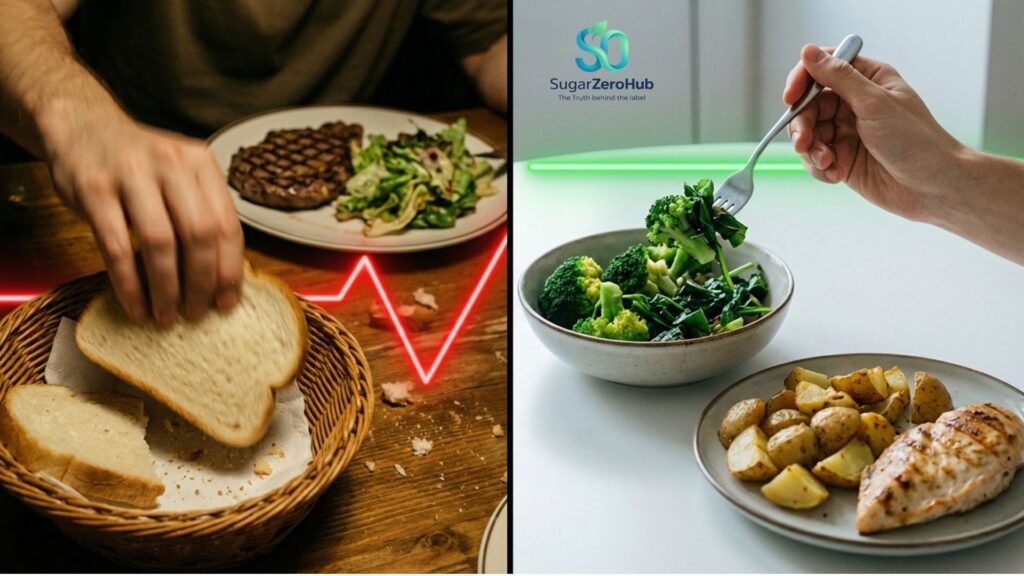
What if you could eat the exact same meal you are eating right now, but reduce the resulting blood sugar spike by up to 73%? You don’t have to cut out your favorite foods, count a single calorie, or eat smaller portions.
You just have to change the order in which you eat them.
Welcome to the science of Food Sequencing. It is one of the most powerful, scientifically proven metabolic hacks available today, and it completely changes the rules of blood sugar control. Here is exactly how it works and how you can start using it at your very next meal.
The Anatomy of a Glucose Spike
When you sit down at a restaurant, what is the first thing they put on the table? A basket of bread. When you are starving, you reach for the bread first.
Metabolically, this is the worst possible start to a meal. When you eat carbohydrates (like bread, rice, or pasta) on an empty stomach, they are rapidly broken down into glucose and dumped straight into your bloodstream. Your blood sugar rockets upward, forcing your pancreas to release a massive wave of insulin to deal with the emergency.
The “Fiber Armor” Strategy
To flatten the curve, you need to create a physical barrier in your digestive system before the carbohydrates arrive. You do this by eating your food in a specific, strategic order:
1. Vegetables First (The Armor) 2. Proteins and Fats Second (The Satiety) 3. Starches and Sugars Last (The Reward)
When you eat fibrous vegetables first (like a side salad, roasted broccoli, or asparagus), the fiber coats the lining of your upper intestine. It creates a viscous, gel-like mesh.
When you follow the vegetables with protein and healthy fats, you further slow down the emptying of your stomach. Finally, when you eat your carbohydrates at the very end of the meal, that sugar hits the “fiber armor.” The glucose is absorbed into your bloodstream slowly and steadily, rather than all at once.
The Real-World Results
Studies have shown that eating your meal in this exact order—Veggies, Protein, then Carbs—can reduce your post-meal glucose spike by up to 73% and your insulin spike by 48%, compared to eating the exact same foods in reverse order.
You get to enjoy your pasta or potatoes, but your body reacts as if you ate a fraction of the carbohydrates. You avoid the post-meal energy crash, you stay full for hours, and your fat cells remain unlocked.
Master the Rules of Your Metabolism
Food sequencing is an incredibly powerful tool, but it is just one chapter in the ultimate playbook of metabolic health. Once you understand how to sequence your meals, you need to know how to navigate breakfast, sleep, and stress to completely reverse insulin resistance.
We have built a comprehensive roadmap that puts all these strategies into one simple, daily routine.
Take total control of your metabolism: Read The Ultimate 2026 Guide to Mastering Your Blood Sugar here
Conclusion
You do not have to live a life of strict deprivation to achieve stable blood sugar. By simply rearranging the order of the foods on your plate—starting with fiber and ending with starches—you can actively protect your metabolism, silence your cravings, and still enjoy the foods you love.