
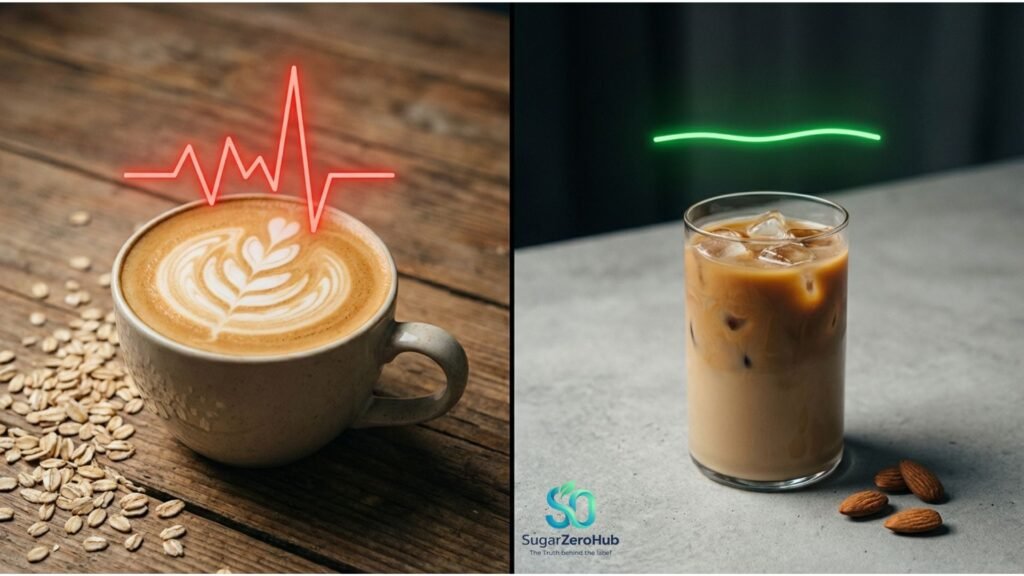
You walk into your favorite coffee shop and order your morning latte. Trying to make a healthy choice, you ask the barista to substitute regular dairy for oat milk. You feel good about your decision. It is plant-based, trendy, and marketed as the ultimate health food.
But two hours later, your energy crashes, your brain is foggy, and you are craving a sweet snack. What happened?
You just fell victim to one of the biggest hidden dangers in the modern health food industry. Your “healthy” oat milk latte didn’t fuel your morning; it secretly blasted your bloodstream with a massive sugar spike. Here is the hidden science behind the oat milk deception and why you need to rethink your morning cup.
The Maltose Problem
To understand why oat milk is a metabolic disaster, you have to look at how it is made. Oats are a grain, which means they are made entirely of starches (complex carbohydrates).
When manufacturers make oat milk, they don’t just blend oats and water. They add special enzymes to break down the thick oat starches into simple sugars so the liquid becomes sweet and creamy. The primary sugar created in this process is maltose.
Here is the terrifying part: Maltose has a Glycemic Index (GI) of 105. To put that in perspective, pure glucose is 100, and standard table sugar is 65. The sugar in oat milk literally spikes your blood glucose faster and higher than eating pure sugar out of a bowl.
The Liquid Spike and The Missing Fiber
If you ate a bowl of whole oatmeal, your body would have to break down the fiber, which slows down the release of glucose. But in oat milk, the solid fiber is completely strained out and thrown away.
What is left in the carton is a highly concentrated, liquid carbohydrate. Liquid sugar requires zero digestion. The moment you drink that oat milk latte on an empty stomach, the maltose instantly floods your bloodstream.
Your pancreas panics and releases a massive wave of insulin to clear the sugar. This forces your body to store the excess energy as belly fat and triggers a rapid blood sugar crash, leaving you exhausted and hungry before lunch.
3 Safe Swaps for Your Morning Coffee
You don’t have to give up your morning coffee routine, but you do need to swap your milk to protect your metabolism.
- Unsweetened Almond or Macadamia Milk: These nut-based milks are mostly water and healthy fats. They contain almost zero carbohydrates and will keep your blood sugar completely flat. Always check the label to ensure it says “Unsweetened.”
- Heavy Cream (or Half-and-Half): If you tolerate dairy, a splash of full-fat heavy cream is metabolically excellent. The pure fat slows down the absorption of the caffeine and does not trigger an insulin response.
- Black Coffee After Breakfast: The absolute worst time to drink liquid carbohydrates is on an empty stomach. If you absolutely must have oat milk, drink it after you have eaten a high-protein breakfast.
Expose the Hidden Dangers
Oat milk is just the tip of the iceberg. The grocery store shelves are packed with “healthy” alternatives that are secretly driving the epidemic of insulin resistance.
To learn how to read past the marketing labels, identify hidden sugars, and build a bulletproof metabolism, you need the complete strategy.
Stop falling for food industry traps: Read The Ultimate 2026 Guide to Mastering Your Blood Sugar here
Conclusion
Don’t let clever marketing ruin your metabolic health. Oat milk is not a health food; it is highly processed, liquid starch that spikes your blood sugar worse than a soda. By swapping to zero-carb alternatives like unsweetened almond milk or heavy cream, you can enjoy your morning coffee while keeping your insulin low and your energy stable all day.