
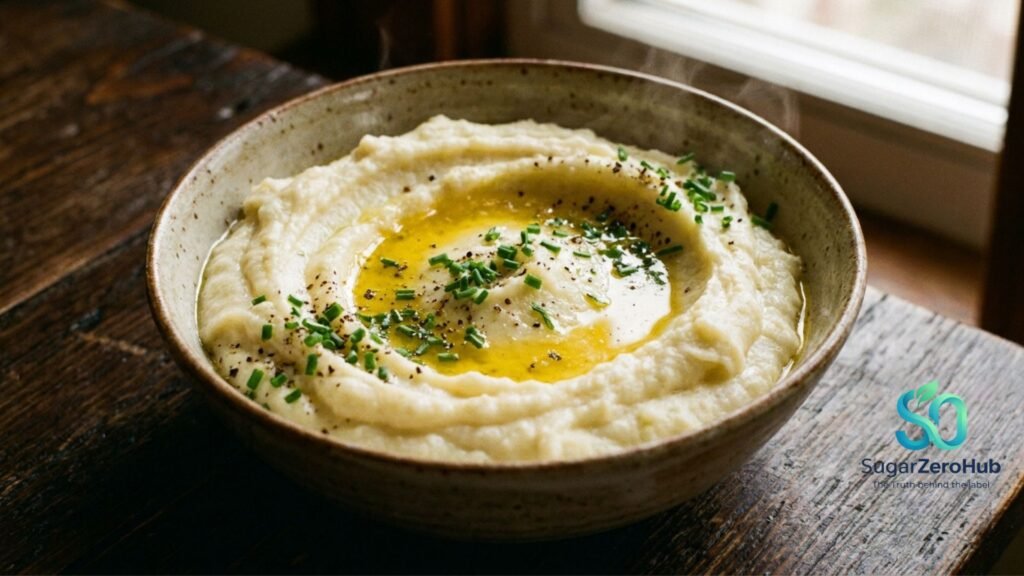
It is dinner time, and you are craving classic comfort food. You want something warm, rich, and deeply satisfying—like a massive bowl of buttery mashed potatoes. If you are working to reverse insulin resistance or prevent diabetes, you know that traditional potatoes are a metabolic minefield.
Most people try to substitute them with a basic cauliflower mash, only to end up with a sad, watery, flavorless vegetable puree that leaves them unsatisfied and craving the real thing.
It does not have to be this way. You can absolutely enjoy the rich, decadent texture of comfort food without destroying your glucose curve. The secret is not in the vegetable itself, but in the culinary technique. Here is the ultimate recipe for the “Comfort Food Illusion”—a gourmet cauliflower mash so creamy and buttery that it will fool your brain, satisfy your cravings, and keep your blood sugar completely flat.
The Starch Bomb vs. The Fiber Matrix (The Science)
To understand why traditional mashed potatoes provoke such a severe glycemic response, we must examine their molecular structure. Potatoes are predominantly composed of amylopectin, a highly branched glucose polymer that digestive enzymes rapidly dismantle into pure glucose. Because cooked potatoes are completely pulverized, they require virtually zero digestive transit time. Consuming a bowl of mashed potatoes spikes blood sugar at a rate comparable to drinking a sugary soft drink.
Cauliflower, conversely, is a non-starchy cruciferous vegetable packed with an intact cellular fiber matrix. It contains negligible amounts of fast-acting carbohydrates. When consumed, it passes through the digestive tract gradually, causing zero disruption to your baseline glucose levels.
The primary challenge is chemical: cauliflower is roughly 92% water. If you simply boil it and mash it, the retained water prevents fats from binding, resulting in a separated, unappetizing texture.
The Secret to the Illusion: Lipid Emulsification
The reason restaurant-quality mashed potatoes taste so indulgent is due to the scientific principle of fat emulsification. To replicate this exact mouthfeel using cauliflower, we must aggressively remove its natural moisture and replace it with high-quality, metabolically protective lipids.
By incorporating grass-fed butter or rich heavy cream, we do not just improve flavor; we actively optimize the meal’s metabolic safety profile. Saturated fats from clean sources slow down gastric emptying. This structural delay ensures that any remaining carbohydrates are absorbed over an extended window, stabilizing your energy levels and triggering the release of leptin—the hormone responsible for long-term satiety.
Recipe Card: Gourmet Zero-Spike “Mashed Potatoes”
- Prep Time: 10 minutes
- Cook Time: 25 minutes
- Servings: 3 portions
Macro Profile per Serving
| Nutrient | Value | Metabolic Impact |
| Total Carbs | 7g | Minimal glycemic load |
| Dietary Fiber | 3g | Supports gut microbiome stability |
| Net Carbs | 4g | Ideal for strict glucose management |
| Healthy Fats | 12g | Sustained satiety and energy anchoring |
Ingredients
- 1 large head of fresh cauliflower, cut entirely into uniform florets
- 3 tablespoons high-quality grass-fed butter
- 2 tablespoons organic heavy cream (or plain full-fat Greek yogurt for a tangy profile)
- 2 tablespoons freshly grated Parmigiano-Reggiano cheese
- A generous pinch of fine sea salt
- 1/2 teaspoon organic garlic powder
- Black pepper to taste
- Optional: 2 teaspoons of cold-pressed extra virgin olive oil for roasting
Step-by-Step Instructions
- The “Dry Roast” Method: Never boil your cauliflower. Boiling saturates the vegetable walls with excess water, ruining the final texture. Instead, toss the cauliflower florets in a light drizzle of olive oil and spread them evenly onto a baking sheet. Roast in the oven at 400°F (200°C) for 25 minutes until the edges are fork-tender and slightly charred. This process evaporates the internal moisture and concentrates the natural, nutty sugars of the vegetable.
- The Lipid Integration: Transfer the hot, roasted cauliflower immediately into a high-powered food processor. Do not use a manual potato masher; mechanical blades are required to create a truly uniform, silky texture. Add the grass-fed butter, heavy cream, sea salt, black pepper, and garlic powder directly over the hot florets.
- The Emulsification Blend: Blend the mixture on high speed for a full 60 seconds. To achieve the signature “comfort food” density, pause the processor, add the grated Parmigiano-Reggiano cheese, and blend for an additional 10 seconds. The cheese acts as a natural binding agent, pulling the lipid emulsion into a thick, luxurious, gourmet puree.
Conclusion: Redefining Comfort Food
You do not have to abandon comfort food to achieve a lean, insulin-sensitive body. The problem with traditional dishes is the immediate starch overload, but by shifting your strategy to vegetable-based fiber matrices emulsified with healthy fats, you can engineering a clean culinary masterpiece. This buttery mash satisfies your psychological cravings for richness while protecting your systemic metabolic health.
Metabolic Optimization: To turn this side dish into a complete glucose-stabilizing powerhouse, pair it with a high-quality protein source, such as grass-fed ribeye steak, roasted chicken breast, or wild-caught salmon.
To master the complete science of carbohydrate substitution and build a lifestyle free of energy crashes, read The Ultimate 2026 Guide to Mastering Your Blood Sugar here.